Junior pathway
Uses shorter activities, more demonstration and repetition. Lessons usually last 45–50 minutes with up to six learners.
 Abacus ExpertsMental maths built on method
At Abacus Experts, we provide live, level-based classroom abacus classes in Hyderabad for children aged about 5 to 13. We teach correct physical-abacus technique, accurate number skills and gradual mental arithmetic at our Hyder Nagar centre near JNTU Metro Station.
Verified course information
Review our trainer, classroom structure, fee and contact details before booking a free demo. We confirm exact days, start times and available seats directly because schedules can change.
| Trainer name | Joshna |
|---|---|
| Trainer experience | 10 years |
| Age guide | About 5–13 years; final pathway follows our readiness assessment |
| Training mode | Face-to-face classroom learning in Hyder Nagar |
| Class frequency | Two live classes each week |
| Junior batch | 45–50 minutes · up to 6 learners |
| Senior batch | 55–60 minutes · up to 8 learners |
| Course fee | ₹20,000 Classroom |
| Course inclusions | Physical abacus kit included · EMI available |
| Current demo session | Contact us to confirm the next date, time and open seats |
| Call us | +91 90325 89990 |
| Email us | abacusexperts.com@ |
Step-by-step learning roadmap
Our curriculum begins with correct physical-abacus use and place value. We then develop arithmetic, visualisation and mental calculation step by step. We recommend progression after the child shows stable technique and accuracy. Our readiness assessment decides the entry point, and every learner progresses at an individual pace.
Uses shorter activities, more demonstration and repetition. Lessons usually last 45–50 minutes with up to six learners.
Moves at a pace suited to older beginners or continuing learners. Lessons usually last 55–60 minutes with up to eight learners.
We do not move a child forward through attendance alone. We check technique, place value, accuracy, independence and visualisation.
Book our free readiness check to identify the right curriculum starting point.
Book free readiness assessment →A better starting point
Abacus is a hands-on way to learn arithmetic. Children first move beads to understand numbers and place value. Later, when their method is stable, they practise picturing the abacus and calculating mentally.
No previous experience is needed. We check number recognition, counting and readiness first.
We keep the skills a child knows and fix gaps instead of guessing a level.
Following instructions and basic number skills matter more than age alone.
Not sure whether your child is ready? A short assessment gives you a clear answer.
Book free readiness assessment →Why families compare us
We explain our trainer’s experience, batch limits, teaching method, course fee and progression rules before enrolment. We focus on clear teaching and realistic outcomes—not broad promises.
Our free readiness check helps us recommend a suitable pathway and starting point before payment.
Junior batches have up to six learners and senior batches have up to eight. Children learn with others at a similar level.
Our lead trainer, Joshna, has 10 years of abacus teaching experience.
We watch posture, finger movement, bead placement and place value throughout classroom lessons.
Speed follows a stable method. Children progress after showing the required skills, not only by attending classes.
We show parents what each stage teaches, from physical abacus technique to mental arithmetic and visualisation.
We explain the child’s strengths, practice needs and next learning step in simple language.
Children attend face-to-face lessons at our centre near JNTU Metro Station.
We publish the ₹20,000 classroom fee, provide an EMI option and include a physical abacus kit.
We explain our admissions process and course details in English or Telugu.
We explain that results vary and do not promise higher IQ, guaranteed marks or the same outcome for every child.
Compare our trainer, batch size, method, fee and progression before choosing a programme.
Book free readiness assessment →A parent-first institute comparison
Many Hyderabad providers offer useful basics such as online or classroom lessons, a level-based curriculum, regular practice and demo classes. Abacus Experts goes further by making placement, batch limits, technique correction and progression clearer before enrolment.
Online or offline lessons, arithmetic levels, worksheets, assessments, flexible timings and free demos.
Readiness-based placement, published batch limits, visible technique checks, accuracy-first progression, written policies and honest outcome limits.
| What parents should compare | Common information on provider pages | Abacus Experts approach | Why it matters |
|---|---|---|---|
| Before-enrolment check | Free demo or general level placement is common | Free readiness assessment before payment | Checks whether the child is ready, not only which batch has space |
| Placement method | Age and skill placement may be mentioned | Readiness, age, number skills and previous learning are checked | Reduces the risk of starting too high or too low |
| Maximum batch size | “Small batches” is often stated without a number | Up to 6 junior and 8 senior learners | Parents can judge how much observation is realistic |
| Level grouping | Structured levels are commonly offered | Small, level-matched groups—not mixed only to fill a batch | The lesson pace suits the learners in the group |
| Physical technique | Bead movement and hands-on practice are usually taught | Posture, finger movement and bead placement are observed live | A correct answer does not hide an incorrect method |
| Speed and accuracy | Speed training is commonly promoted | Accuracy and stable method come before speed | Prevents fast but unreliable calculation habits |
| Progression | Levels and regular assessments are common | Progression depends on demonstrated technique and independence | A child does not move up through attendance alone |
| Parent updates | Progress reports or feedback may be provided | Plain-language updates with strength, practice need and next step | Parents understand what progress actually means |
| Online quality | Live online classes are widely available | Physical abacus plus camera view of the hands and beads | The trainer can correct technique, not only hear answers |
| Fee transparency | Price pages or fee enquiries are common | Complete written fee checklist and policy terms before payment | Parents can compare tuition, materials and extra charges |
| Outcome claims | Focus, memory and academic benefits are often promoted | No guarantee of IQ, photographic memory or school marks | Parents receive a realistic description of what abacus can support |
| Returning learners | Previous experience may be considered | Re-assessment checks retained skills and learning gaps | The child does not repeat everything or skip weak foundations |
We reviewed publicly visible Hyderabad provider and marketplace pages in September 2026. “Common information” means a feature appears across the market; it does not mean every institute provides it in the same way. Parents should confirm the current offer directly with each provider.
Compare the complete learning process—not only the fee or a ‘best institute’ claim.
Book free readiness assessment →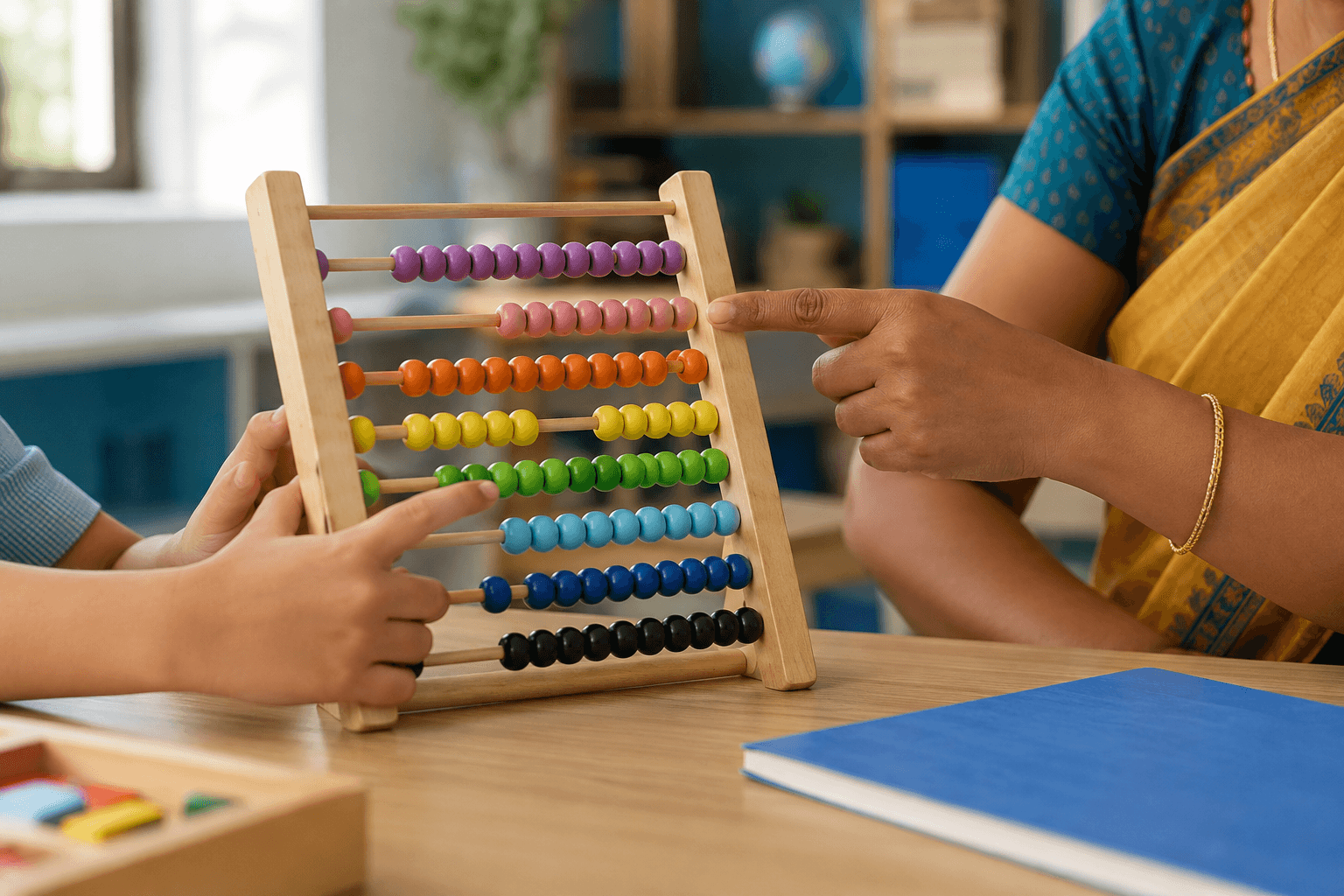
Simple idea, careful method
An abacus is a frame with movable beads. Each bead position represents a number value. Moving the beads helps a child see how numbers are built and how arithmetic steps work.
Children begin with a physical abacus. As technique and place-value knowledge improve, they start to picture bead movements in their mind. This is called visualisation, and it should be introduced step by step.
See which level fits your childBefore your child begins
No previous abacus experience is needed. We check a few simple readiness signs so the child can learn comfortably at the right starting level.
Can recognise common numbers appropriate for their age.
Can count in order with reasonable confidence.
Can listen to and follow one or two simple steps.
Can stay with a guided activity for a short period.
Can move small objects or beads with reasonable comfort.
Can attend classes and complete short home-practice sessions.
Let us check readiness before you select a level or batch.
Book free readiness assessment →Clear learning outcomes
We develop practical number skills step by step. Your child’s progress depends on correct technique, regular attendance and suitable home practice.
We teach correct posture, finger movement and bead placement.
We help children understand how ones, tens, hundreds and larger numbers are organised.
We teach addition, subtraction, multiplication and division according to the assessed level.
We gradually introduce calculation without the physical abacus after the foundation becomes stable.
We teach children to picture bead movement clearly instead of guessing an answer.
We build speed only after the method and accuracy become dependable.
We guide children towards completing suitable exercises with less prompting.
We help children notice and correct an incorrect bead position or calculation step.
We encourage a short, regular and methodical practice routine.
Ask us which skills we teach and assess at your child’s recommended level.
Book free readiness assessment →Two pathways, one careful standard
About ages 5–8
Shorter activities, more demonstration and repetition for first-time learners.
About ages 8–13
A faster pathway for older beginners or children continuing earlier learning.
From enquiry to first lesson
We check number skills, attention and previous learning.
We recommend a pathway and starting point that is challenging but manageable.
Our trainer demonstrates each method, observes bead work and corrects technique.
We usually recommend 10–15 minutes of focused practice on several days each week.
We check technique, accuracy and independence before recommending the next stage.
Let us identify the right starting point before you choose a batch.
Book free readiness assessment →Clear classroom pricing
Our Hyderabad Classroom course fee is ₹20,000. We include a physical abacus kit and provide an EMI option. Ask us for the current batch and written payment terms before enrolment.
Learn face to face with our trainer at our Hyder Nagar centre near JNTU Metro Station.
The method behind each lesson
We show, practise, check and explain each learning step. We build correct technique and accuracy before controlled speed.
Our trainer shows the bead movement slowly and explains what each step means.
Your child copies the method on a physical abacus while our trainer observes.
We correct finger or bead-placement errors before they become repeated habits.
We ask the child to repeat the calculation without continuous help or guessing.
We introduce mental practice after the physical-abacus foundation becomes stable.
See how we check the method—not only the final answer.
Book free readiness assessment →Abacus classes near me in Hyderabad
Our abacus institute in Hyderabad serves families from Hyder Nagar, Nizampet, KPHB, Kukatpally, Miyapur, Bachupally and nearby areas. Read our Hyderabad service-area guide, join classroom abacus training at the centre or choose live online classes anywhere in Hyderabad.
Practice without pressure
We recommend short, correct and regular practice instead of long, irregular sessions.
We usually suggest practice on several days each week in a quiet place. Follow our trainer’s method and stop when tiredness causes repeated errors.
Set a regular practice time, encourage effort and share any difficulty with our trainer. Please do not complete the answers for your child.
We adjust the practice plan according to your child’s level, accuracy and confidence.
Book free readiness assessment →Useful, realistic outcomes
Abacus is mainly a structured arithmetic method. Results differ by learner, teaching quality and practice.
Independent and official reading
Research reports possible gains in arithmetic, numerical processing and visuospatial working memory, while official Indian education resources explain the wider importance of foundational numeracy. These sources do not endorse Abacus Experts, and individual results vary.
We do not promise higher IQ, photographic memory, “whole-brain activation,” guaranteed marks or the same result for every child. Abacus does not replace the full school maths curriculum.
Use the free assessment to decide whether this method suits your child now.
Book free readiness assessment →A personal decision, not a general promise
Abacus can be a good fit when a child is ready for guided number practice and can attend consistently. A readiness check is more useful than choosing only by age.
A later start is not a failure. Beginning when the child is ready usually creates a calmer learning experience.
Let us check readiness before you choose a batch or pay a fee.
Book free readiness assessment →Progress parents can understand
We recommend the next stage after your child demonstrates the required skills. Attendance alone does not show that a learner is ready.
Example progress update
Current strength: Correct direct addition with stable finger movement.
Needs practice: Big-friend subtraction without prompts.
Next step: Three short practice sets before the next review.
Ask us how often we share progress updates for your child’s batch.
Book free readiness assessment →Trust starts with our trainer
We believe parents should know who will teach their child before enrolling.
Our lead abacus trainer has 10 years of abacus teaching experience. Ask us which levels, formats and current batches she handles.
10 years’ experienceParent feedback on classroom abacus training
Read two parent-provided excerpts below, then visit the dedicated reviews page for all six comments and our review-transparency note. Individual outcomes vary.
“My son used to take forever with simple subtraction, and homework time was a daily battle. Three months into classroom sessions here, he's doing two-digit sums in his head without reaching for his fingers. The instructor also gives us a quick note after each class on what he practiced, so I know exactly where he stands.”
“What sold me was sitting in on a trial class and watching other kids in the batch actually enjoying it instead of dreading it. My daughter now asks on weekends when her next class is. She's also started doing quick calculations out loud at home, which she never did before.”
Read all parent-provided feedback and learn how to evaluate reviews.
View all parent reviews →A clear parent checklist
Ask for maximum batch size
Check trainer qualifications
Read the complete syllabus
Understand level placement
Ask how technique is corrected
Check the complete fee
Review assessment methods
Read genuine local reviews
Compare class formats
Avoid guaranteed-result claims
Different methods for different ages
| Factor | Abacus | Vedic Maths |
|---|---|---|
| Approach | Bead-based number representation | Formula-based calculation |
| Physical tool | Uses an abacus first | Usually no tool |
| Typical learner | Often younger children | Often older children with arithmetic basics |
| Focus | Place value, arithmetic and visualisation | Calculation techniques |
One method is not automatically better. The choice depends on age, readiness, maths foundation and learning goal.
Share your child’s age and experience for a suitable recommendation.
Book free readiness assessment →Clear local answers from Abacus Experts
These answers focus on our Hyder Nagar classroom location, fee, batches, age and enrolment. The dedicated FAQ page covers the complete course.
Our classroom centre is in Hyder Nagar, near JNTU Metro Station, at Metro Pillar A689. We serve families from Hyder Nagar, Nizampet, KPHB, Kukatpally, Miyapur, Bachupally and nearby areas.
Our course fee is ₹20,000 for Hyderabad Classroom learning. Live Online classes cost ₹18,000. EMI is available, and a physical abacus kit is included in both formats.
We limit junior batches to six learners and senior batches to eight learners. We also place children with others at a similar learning level.
We normally conduct two live classes each week. Our junior lessons usually last 45–50 minutes, while our senior lessons usually last 55–60 minutes.
Your child should bring the materials listed for the selected level, which may include the included physical abacus kit, workbook, pencil and assigned worksheets. We provide the final materials list during enrolment.
At Abacus Experts, we teach children to represent numbers and solve arithmetic using a physical bead frame. After the physical method becomes stable, we gradually introduce bead visualisation and mental arithmetic.
We usually guide children from about five years of age. However, we check number recognition, counting, attention and the ability to follow short instructions before recommending a starting level.
Start with our free readiness assessment. We will explain the recommended pathway, starting point, class mode, fee and current batch options before you review the policies and complete enrolment.
Still unsure? Ask us during the free readiness assessment.
Book free readiness assessment →Our simple admission process
We explain the recommended pathway, complete fee and available batch before you make a payment.
Tell us the age, previous abacus experience, preferred class mode and the programme you have in mind.
We assess readiness and confirm whether Junior or Senior Abacus is the right starting point.
We explain the complete fee, EMI option, kit inclusion and current batch choices.
Once your registration is approved you can create your login and start learning.
Our admissions support
Call or WhatsApp us for the current demo, course fee and open seats.
+91 90325 89990Start enrolment on WhatsAppNo payment. No pressure.
Tell us about your child. We will help you understand readiness, pathway, classroom fee and current batch options before you decide.